

Strilets came for a scaling strategy and left with a reworked product
In brief
Strilets is a Ukrainian ballistic calculator. Its calculations were behind a world record for the longest shot: 4,000 meters.
The team came to us with one question: how to scale the product — which markets to enter, which one first, which audience to bet on and with what strategy. We ran a strategic session, researched the global market and broke down seven competitors feature by feature.
And we found an uncomfortable truth: with its current feature set, the product could not win anywhere. So alongside the market choice we added product hypotheses — and packed it all into a pitch deck.
Key points
We were asked to find a way for the product to scale. We started with the product itself
-
01 · Request
A scaling strategy
Beyond picking a market: understand which markets to enter, which one first, which audience to bet on and what strategy to reach it with.
-
02 · Turn
The product wasn’t ready to compete
2/9The benchmark showed that at the start Strilets covered only 2 of the 9 capabilities the market treats as standard.
-
03 · Solution
Market, product and pitch deck
The US as the first market, an eight-module ecosystem and a pitch deck Strilets now takes to partners and investors.
Proof of precision
Strilets’ strongest argument is a world record
4,000m
August 2025 · Ukraine
- Caliber
- 14.5 mm
- Calculations and corrections
- Strilets
- Scale
- ≈ 38 football fields
Previous records 3,540 m · 20173,800 m · 2023 — Ukraine
The Ukrainian sniper group Pryvyd (“Ghost”) hit a target at 4,000 meters — a new world record for distance. According to Strilets, the ballistic calculations and corrections for that shot were made in their system: at the edge of range, in unstable weather and under pressure.
Our benchmark showed that niche leaders sell through proof of precision — methodology, cases, results. So the record became the core argument of the pitch deck: a result proven in the harshest conditions.
Record data comes from media reports (August 2025) and the Strilets pitch deck.
Strategic session
Before looking at the market, we questioned the team about everything — several times and from different angles
- What core value should Strilets deliver to users?
- Which features are the core of the product?
- What fundamentally sets Strilets apart from competitors?
- What does the ideal use case look like?
- What will a “success story” look like in two years?
- What key risks do you see right now?
- Who are your main users today?
- Which audiences have the most potential?
- What does the ideal Strilets customer look like?
- What path does a user take — from need to regular use?
- Which segments are the priority?
- Which markets could serve as pilots?
- What constraints do app stores, compliance and regulation impose?
- Which monetization models have you already tested?
- What subscription price is built into the model?
- Sell directly to users, or through ranges and instructors?
- What LTV and CAC data do you have — for yourselves and for similar products?
- Which channels have you tested — what worked and what didn’t?
- Which channels are you ready to test first — and why those?
- What budgets are you ready to commit to tests?
- Which KPIs are critical in the first three months?
The questions deliberately repeat from different angles — that’s how the answers get more honest.
Market
We chose the market where the product can win, whatever the headcount
[01] region
North America
- Market share
- 46%
- Size
- $295.6M in 2024
- Competitors
- 22–30 apps
The most developed training infrastructure: over 63M Americans take part in shooting sports and 16M hunting licenses have been issued. Online sales are the main channel.
The largest civilian market, online distribution and a strong shooting-sports culture. The most competitors — which means demand is already proven.
[02] region
Europe
- Market share
- 22%
- Size
- $142M · 7.4% CAGR
- Competitors
- 12–18 apps
Demand is driven by police modernization, shooting sports and strict regulation. Strong local players.
[03] region
Asia and Oceania
- Market share
- 17%
- Size
- $107M · 9.5% CAGR
- Competitors
- 6–10 apps
The fastest growth, driven by defense budgets rather than civilian users.
[04] region
LatAm, Middle East, Africa
- Market share
- 15%
- Size
- emerging markets
- Competitors
- 1–3 apps
These markets are only now taking shape through government security programs.
Scale
The market for shooting training systems is growing steadily — and moving into apps
- 640
- $M — global market in 2024
- 1.3
- $B — expected by 2033
- 8.1%
- average annual growth
- 63+
- million Americans in shooting sports
Competitors
Seven competitors, five dimensions — and an honest answer on what’s missing
| Capability | Applied Ballistics | Kestrel | Lapua | LaserHIT | Range Buddy | Strilets |
|---|---|---|---|---|---|---|
| Accurate ballistic calculation4 of 5 competitors | ||||||
| Free tier + subscription2 of 5 competitors | ||||||
| Training and academy2 of 5 competitors | ||||||
| Practice and gamification2 of 5 competitors | ||||||
| Community and competitions2 of 5 competitors | ||||||
| Own devices and e-commerce4 of 5 competitors | ||||||
| B2B partnerships and integrations2 of 5 competitors | ||||||
| Scenarios for different audiences2 of 5 competitors | ||||||
| AI analysis of shooter errorsno competitor has it |
For each player we analyzed positioning, channels, proof of expertise, monetization and features. The table summarizes our benchmark.
What we found
No product on the market combines professional precision with amateur-level simplicity
- 01
The market gap
There is no single hub that combines precision, training and community. The market lacks solutions with modern UX — and a balance between pro-grade precision and simplicity for amateurs.
- 02
An ecosystem instead of an app
Every strong brand builds an ecosystem around its app: training, devices, community, e-commerce. The app is just the entry point.
- 03
Three audiences, three sets of expectations
Professionals want precision and integrations, hunters want a simple interface and maps, sport shooters want training, analytics and competitions.
- 04
The name sounds strong but unclear
To English speakers, STRILETS reads as a “foreign military-tech word”: intriguing, but it needs context. The potential: a Ukrainian-born precision brand that stands above a mere app.
- 05
Trust is bought with content
Training and proof of precision are the currency of trust in this niche: that’s how Applied Ballistics and Kestrel work.
Position
“The precision of professionals. The clarity for everyone” — a spot that is empty on the market
The precision of professionals.The clarity for everyone.
Professional precisionscience, R&D, complex interfaces
Clarity for everyonesimplicity, gamification, mass reach
Applied Ballistics-level precision — with the accessibility of SBC and Lapua and the community approach of Range Buddy.
An indicative scale based on benchmark findings: each player’s main strength.

Product hypotheses
From a calculator to an ecosystem: each module closes a gap found in the benchmark
CoreThe core that already works: calculations for any weapon, caliber, optics and conditions.
[01] module
AI shooting assistant
Analyzes errors and gives personal advice on how to shoot more accurately.
Closes the gapSomething no competitor in the benchmark has
[02] module
Training Hub
Drills, programs and scenarios that score stability and progress.
Closes the gapTraining — as at Applied Ballistics and Kestrel
[03] module
Shooter analytics
Grouping, statistics and long-range progress.
Closes the gapTraining analytics — as at LaserHIT and Range Buddy
[04] module
Challenges and leaderboards
Rankings, achievements, seasonal competitions.
Closes the gapGamification and community — as at Range Buddy
[05] module
Marketplace for instructors and ranges
Courses, instructors and monetization of training programs.
Closes the gapA B2B model — as at Applied Ballistics and Kestrel
[06] module
Strilets weather station
A field weather module fully integrated into the ecosystem.
Closes the gapOwn hardware — as at Kestrel
[07] module
Adaptive interface
Separate scenarios for professionals, hunters and sport shooters.
Closes the gapSegmentation — as in Lapua Ballistics and Lapua Hunt, inside a single app
Audiences
One platform, three interfaces for different scenarios
The interface concept illustrates the hypothesis: one app with a different depth of data for each audience.
Go-to-market
First market: the US. We built the strategy from how the niche already chooses and trusts
- 01 User journey
How a shooter discovers a new tool, whom they trust and what makes them try an app.
We mapped the path from first contact to regular use and found the points where Strilets earns trust instead of buying attention.
- 02 Who shapes opinion
How category leaders build trust around themselves and who influences choice in the niche.
We identified whom to lean on at launch and with whom it pays more to partner than to compete.
- 03 Retention
Why users come back to training apps — and why they drop them.
We tied growth to the product hypotheses: what has to appear in the product for acquired users to stay.
Pitch deck
14 slides — every investor question is answered before it’s asked

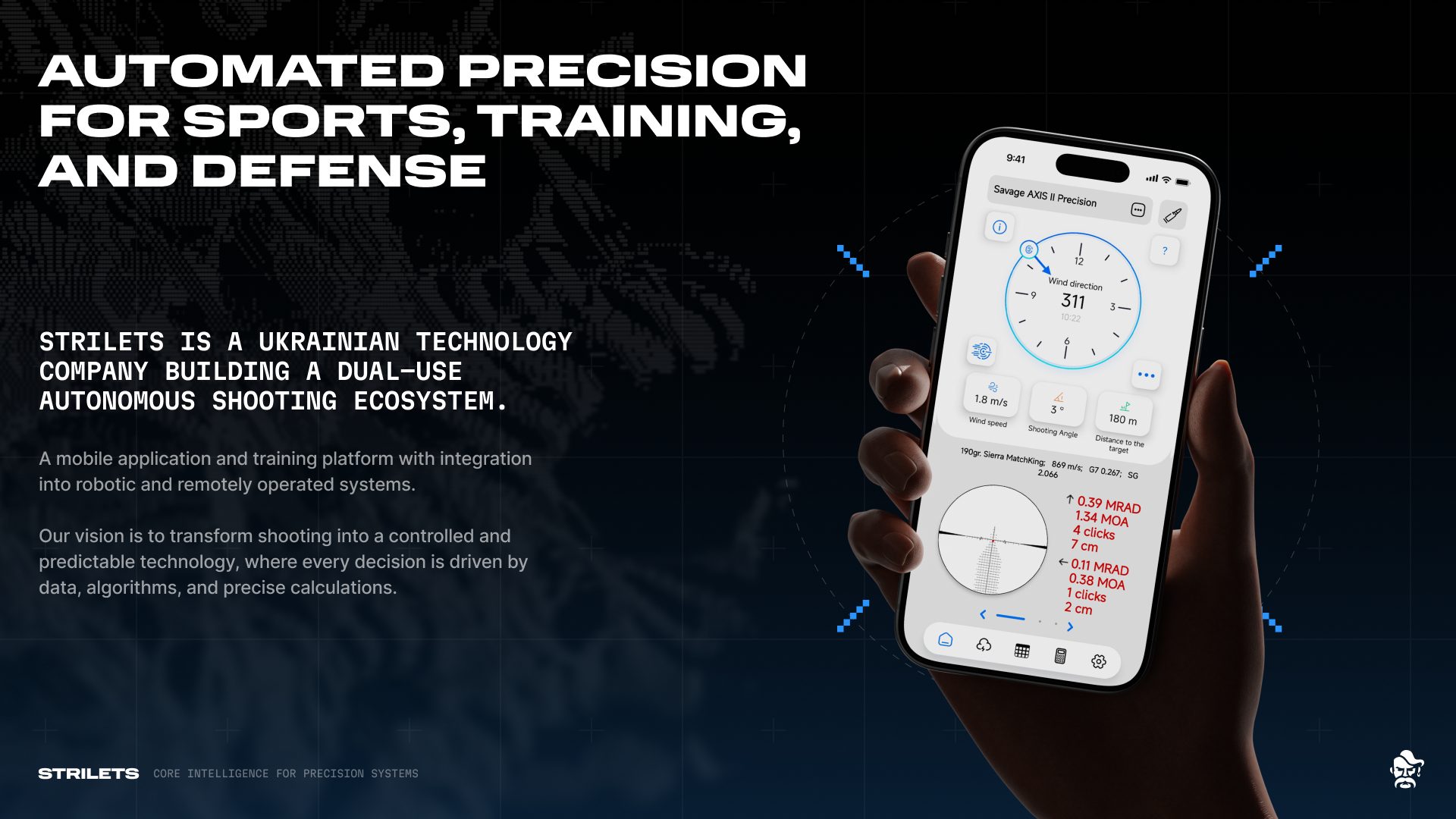
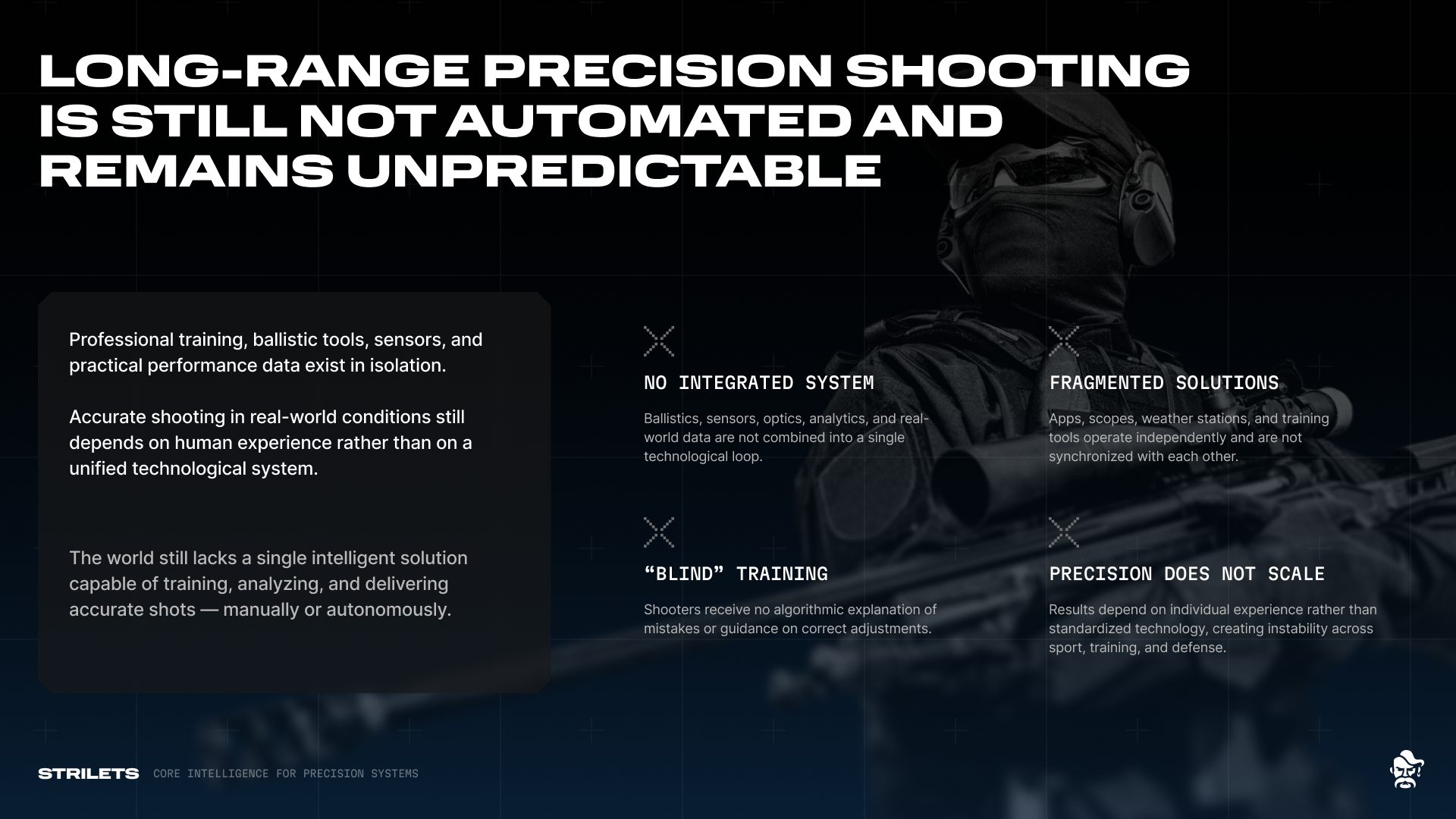
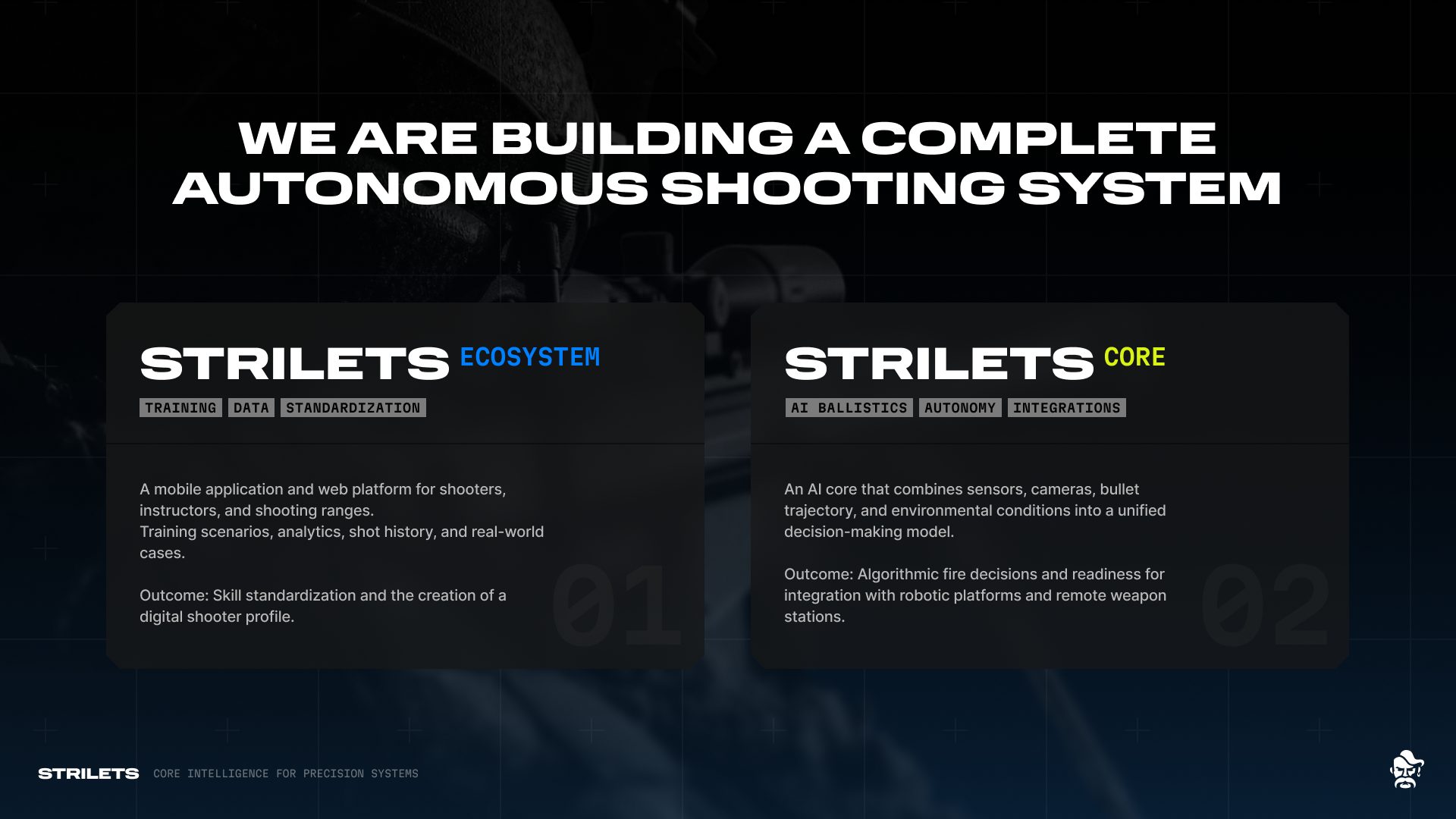
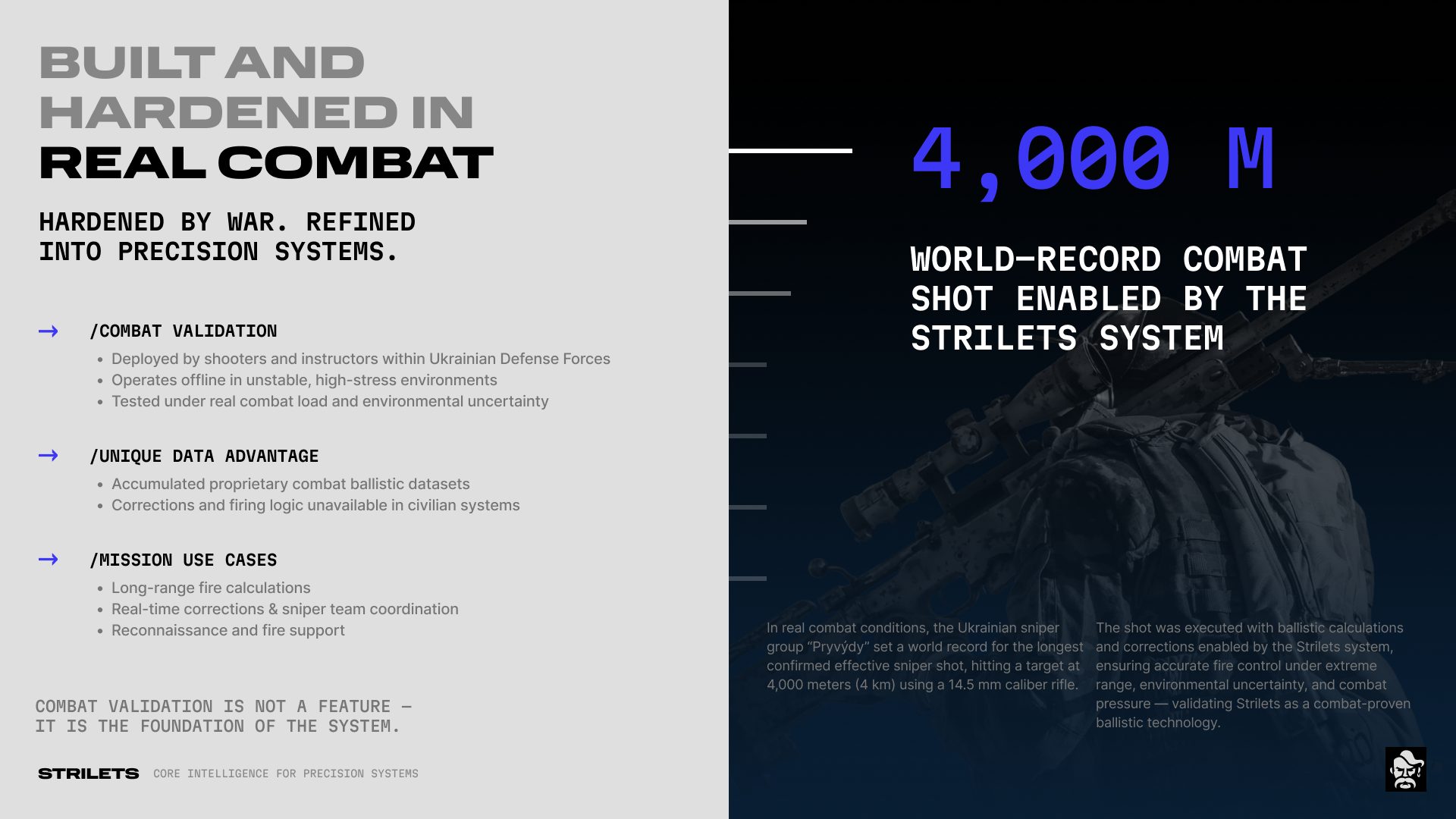



01 / 14Who are you?
Born in Ukraine. Built for precision. Powered by AI. The cover sets the tone right away: precision, technology, Ukrainian origin.
02 / 14What do you do?
A Ukrainian dual-use tech company: an app and training platform for shooters — with a vision of precision as a manageable technology.
03 / 14What problem do you solve?
Ballistics, sensors, optics and analytics exist in silos. Precision still rests on human experience instead of a system — and it doesn’t scale.
04 / 14What are you building?
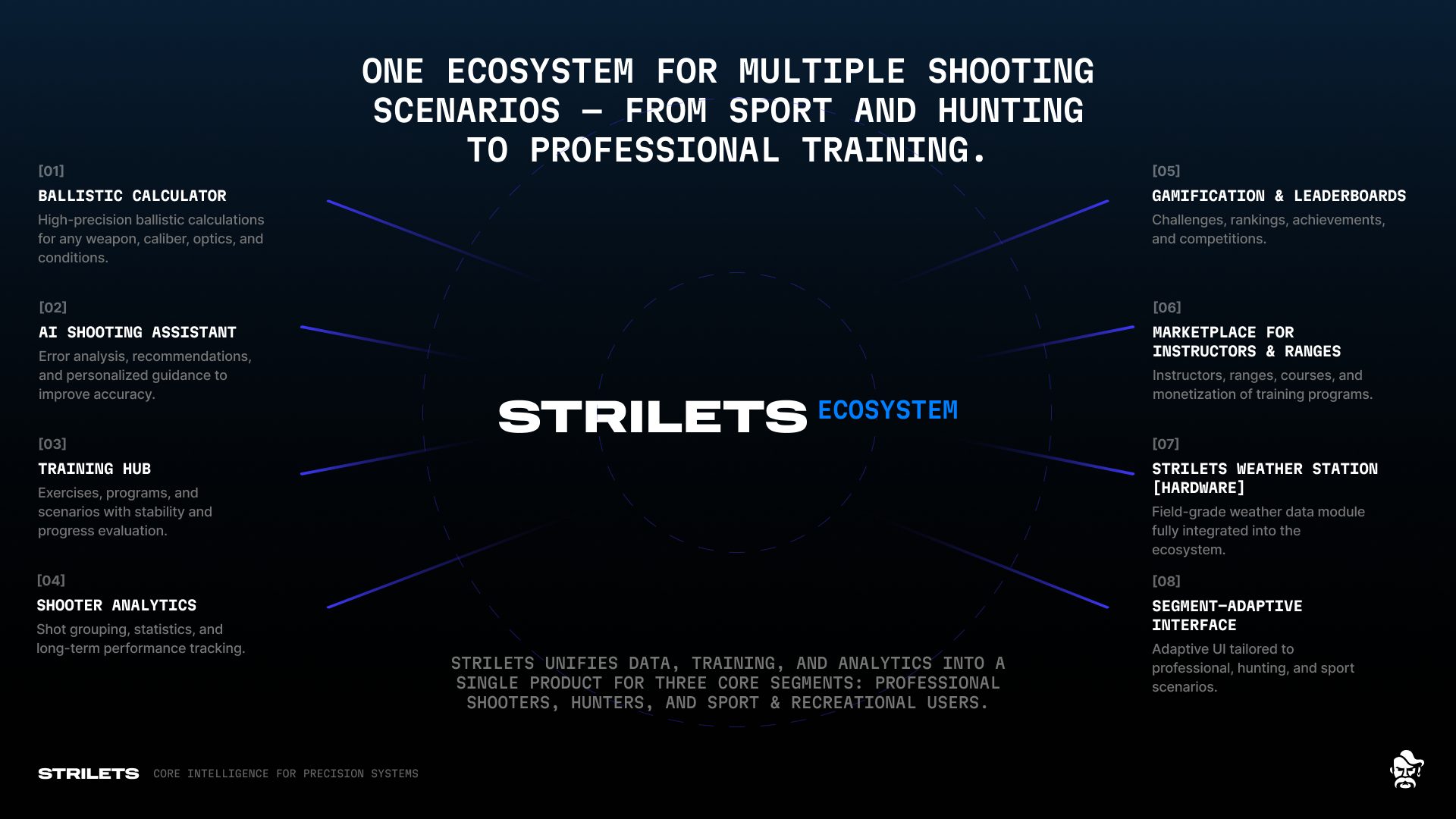
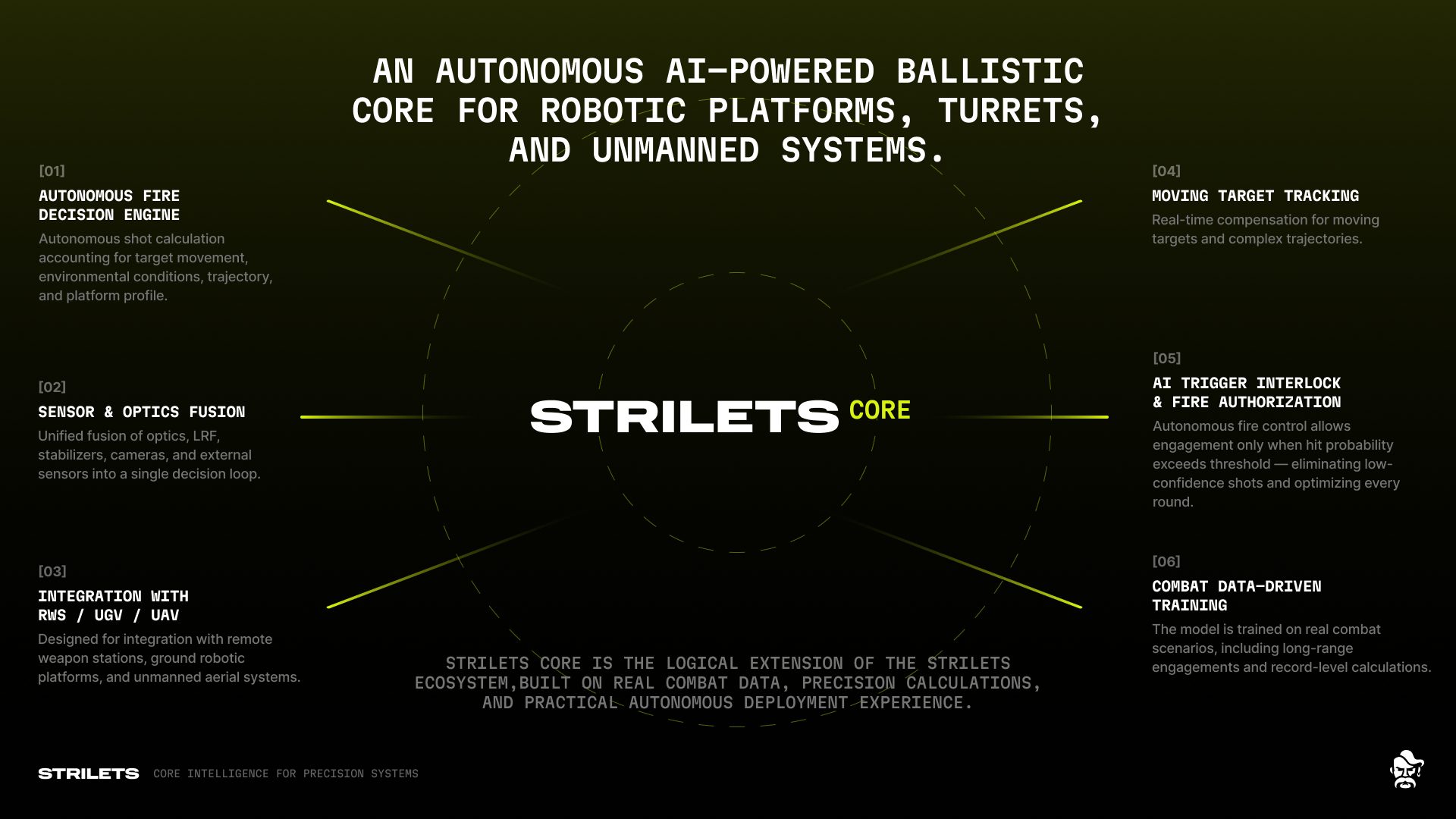
Two product lines: the Strilets ecosystem for shooters, instructors and ranges, and Strilets Core — an AI engine for integration into professional systems.
05 / 14Why should we believe you?
Because the precision is proven in the harshest conditions: a 4,000 m world record, offline operation in unstable environments, unique proprietary data.
06 / 14What does the user get?
Eight ecosystem modules — from the ballistic calculator to an AI assistant, Training Hub, leaderboards and a proprietary weather station.
07 / 14Where is the technology heading?
Strilets Core is the B2B line: an engine that merges sensors, optics and trajectory into a single decision model for professional platforms.
08 / 14How big is the market?
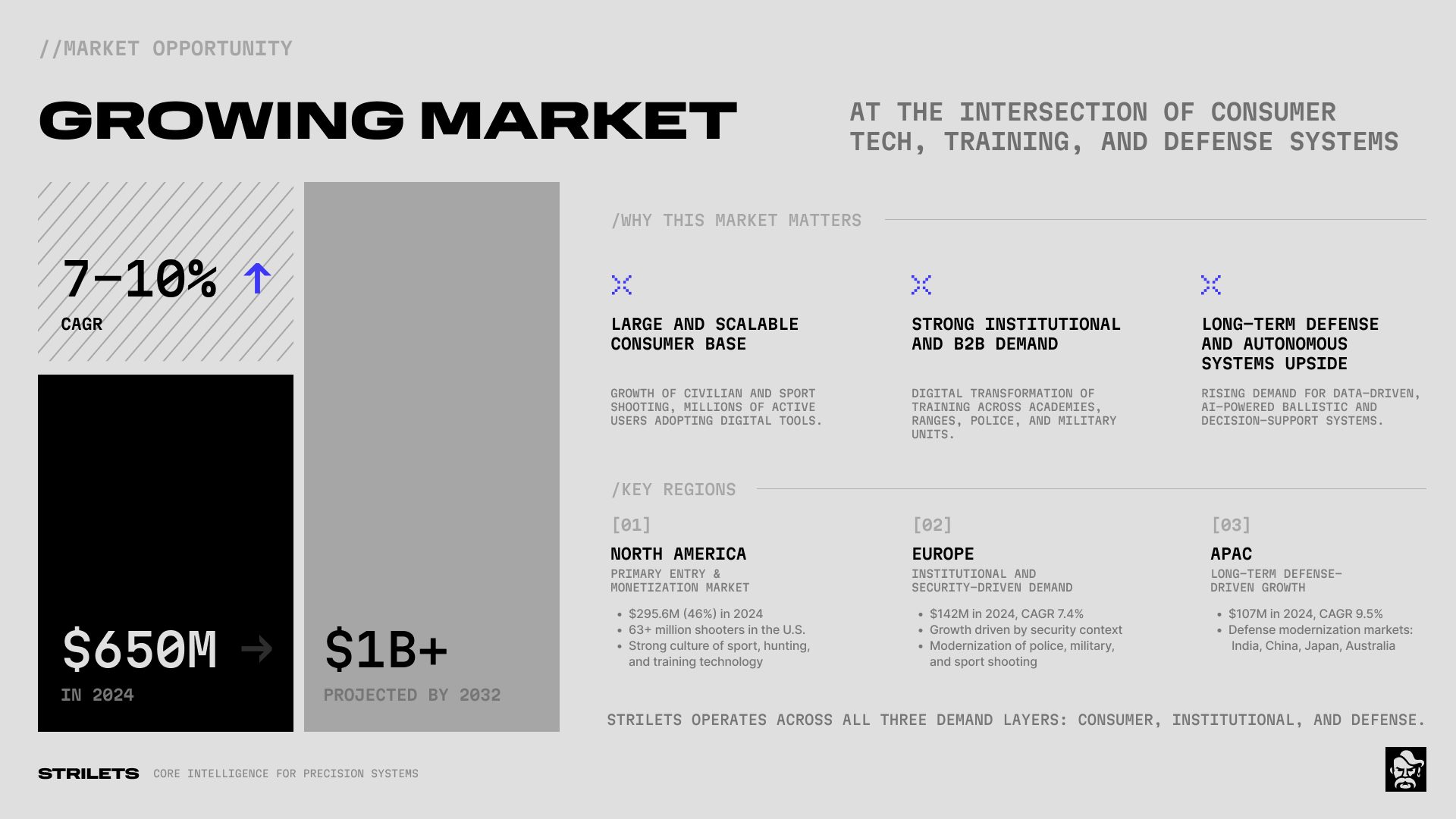
The market at the intersection of consumer tech, training and professional systems grows 7–10% a year. Three key regions, led by North America.
09 / 14How do you make money?
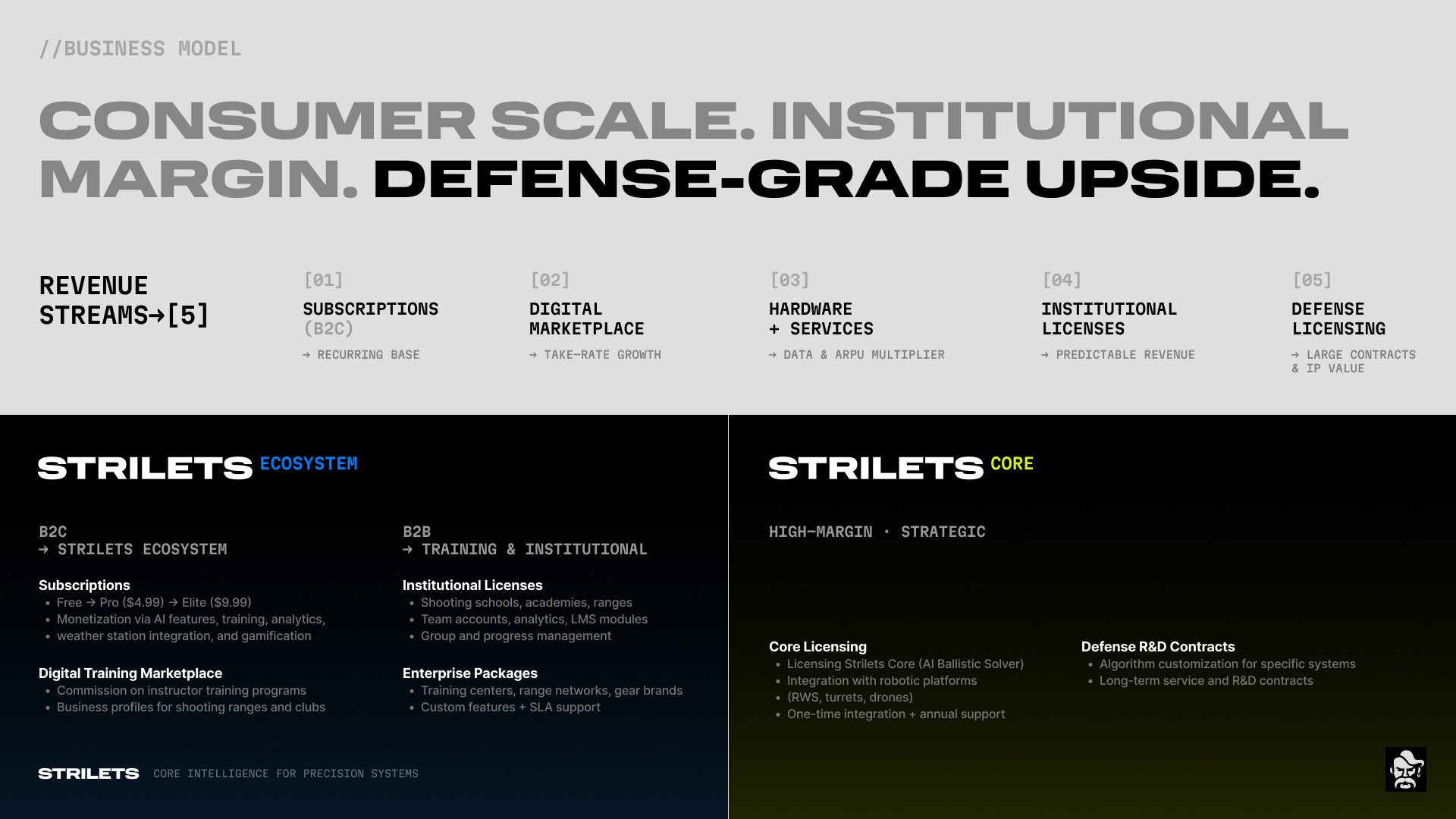
Five revenue streams: subscriptions, a digital marketplace, hardware and services, institutional and B2B licenses. Consumer scale. Institutional margin.
10 / 14How does the business scale?
SaaS economics, reinforced by hardware and institutional licenses. Financial model figures are blurred — this is client data.
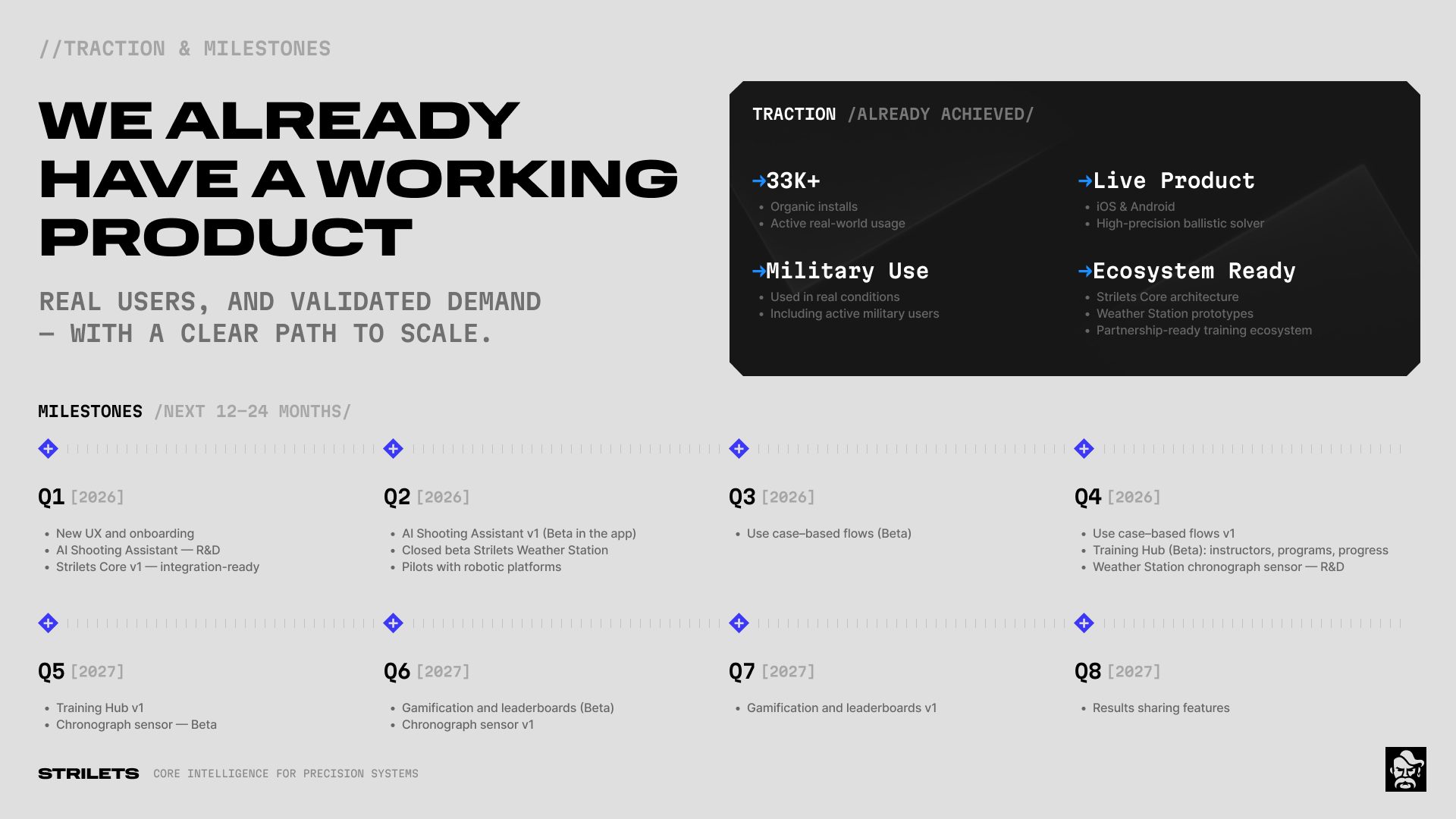
11 / 14What’s already done?
A working product on iOS and Android, over 33,000 organic installs and a 24-month roadmap.
12 / 14How will you enter the market?
The US as the first market and three priority segments. Channels and growth mechanics are blurred — this is the client’s strategy.
13 / 14Who is behind it?
The team responsible for technology, operations and finance. Photos and names are blurred.
14 / 14What will the investment unlock?
How funds will be split between product, team and market entry. The amount and details are blurred — this is client data.
We built the deck as an answer to a partner’s questions: from the problem and proof of precision to the market, model and plan. The financial model, go-to-market, team and investment ask are blurred.
Result
Strilets got the answer to the question it came with: the first foreign market is the US. Along with it — a competitor map, the position “the precision of professionals, the clarity for everyone” and an honest list of what the product lacks to win there.
The biggest result came along the way: instead of ads for a calculator, the team got a product strategy — an ecosystem with training, analytics, community and its own hardware. We packed all of it into a pitch deck that Strilets now takes to partners and investors.
What we’ll do for you
Entering a new market, starting with the product
For when you need to choose a market but aren’t sure the product is ready to compete there. We’ll research the market and competitors, find the gaps and package the strategy into a pitch deck.
- 01 Market research Size, regions, drivers and competitors — backed by data.
- 02 Product hypotheses What to add to the product to win in the market, beyond simply being present.
- 03 Go-to-market and pitch deck The first market, a growth strategy and a story for partners and investors.
Team
- Agency
- DOGMA
- Client
- Strilets